


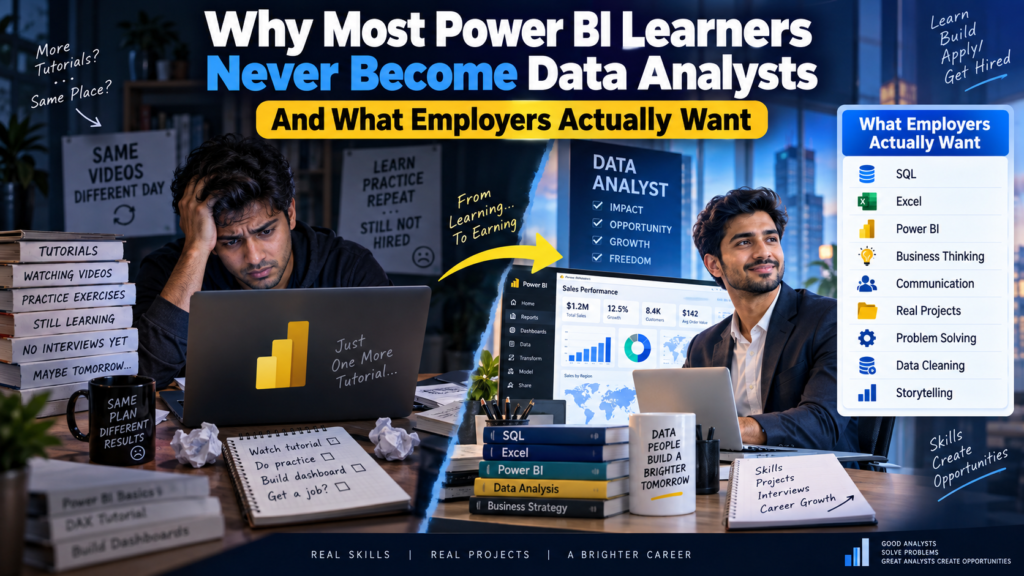
If you want to become a data analyst, finishing a Power BI course feels like crossing the finish line. It isn’t. It’s the starting line, and plenty of people only realise that when the polite rejection emails start arriving.
Thank you for reading this post, don't forget to subscribe!Here’s the thing nobody says out loud: Power BI isn’t the problem. It’s a genuinely useful tool, and plenty of Australian workplaces run their reporting on it. The problem is the gap between what a course teaches and what a hiring manager is trying to decide when your application lands on their desk.
We’ve already covered the common learner mistakes in our guide to why Power BI learners never become data analysts. This article flips the view. Instead of asking what you’re doing wrong, we’ll ask what the person hiring is thinking, so you can become a data analyst by giving them exactly what they need.
What Happens When You Apply to Become a Data Analyst?
Let’s walk through the hiring process from the other side of the desk. It usually looks something like this:
- The résumé scan. Someone, or an applicant tracking system, skims for relevant tools, projects and evidence of results. This takes seconds, not minutes.
- The portfolio check. If you’ve linked a project, they’ll click it. If it’s the same sales dashboard they saw in the last ten applications, it barely registers.
- The phone screen. A recruiter or manager checks that you can talk about your work in plain English.
- The technical task or interview. You might get a small dataset to analyse, or be asked to talk through a model you built.
- The panel conversation. Here they test whether people would enjoy working with you and trust your numbers.
Notice how little of that process is about whether you know where the buttons are. Every stage is the same question wearing a different outfit: if we hand this person our data and our stakeholders, will they cope? That’s what it takes to become a data analyst that employers will back.
Why Power BI Learners Struggle to Become a Data Analyst
Employers aren’t hiring for tool skills. They’re managing risk. A junior analyst who produces a wrong number confidently can cause real damage, from a bad budget call to an awkward conversation with the executive team. So hiring managers quietly ask three questions:
- Can they find and prepare the right data?
- Can we trust what they produce?
- Can they explain what it means to someone non-technical?
A course certificate answers none of those. It says you turned up and completed the exercises, which is worth something, but it’s the same thing every other applicant’s certificate says.
There’s a second problem: sameness. Most learners build their projects from the same handful of sample datasets, so a hiring manager sees near-identical dashboards again and again. If you want to become a data analyst, you don’t need a fancier chart. You need evidence of thinking that nobody else’s application has.
8 Things Employers Actually Want From a New Data Analyst
1. They want you to start with the question, not the chart
The strongest junior analysts ask, “What decision is this supporting?” before they open Power BI Desktop. Who’s the audience? What will they do differently if the number goes up or down? That habit is called requirements gathering, and it’s rarer than you’d think. If you want to become a data analyst, describe every project by starting with the question. You’ll instantly sound like a working analyst rather than a course graduate.
2. They want data they can trust
Real data is messy: duplicate customers, dates in three formats, totals that don’t match finance’s spreadsheet. To become a data analyst employers trust, show that you check your work. Reconcile your totals back to the source, document what you cleaned and flag anything odd. Power Query is your best friend here, and our guide to Power Query vs DAX explains where to focus first. “I found a data quality problem and here’s how I handled it” is gold in an interview.
3. They want a properly built data model
A beautiful report on a shaky model gives wrong answers with great confidence. Hiring managers look for clean relationships, sensible fact and dimension tables (a star schema) and DAX measures that behave when a user filters the page. Microsoft’s own Power BI documentation is a solid free reference. If modelling feels fuzzy, the Power BI Intermediate course covers DAX, drill-through pages and row-level security, and the Power BI Advanced course goes deeper into iterators and time intelligence.
4. They want enough SQL to get to the data
Most business data lives in databases, not tidy spreadsheets. To become a data analyst you don’t need to be a database engineer, but writing a basic SELECT, joining two tables and filtering with WHERE removes a common screening barrier. Practise connecting Power BI to a real database instead of importing a CSV every time.
5. They want someone who can explain the “so what”
Nobody wants a dashboard tour. They want to hear, “Sales in the north dipped after the price change, so I’d test a promotion before next quarter.” Practise the two-sentence summary: what happened, and what you’d do about it. If you can say it out loud without hiding behind jargon, you’re already ahead of most applicants.
6. They want someone who handles data responsibly
Australian organisations take privacy and access seriously, and a careless analyst is a liability. If you want to become a data analyst, know the basics of workspaces, sharing and row-level security so people only see the data they’re meant to. Mention it in interviews. It signals maturity, and it’s covered across our Power BI Beginner course and Intermediate courses.
7. They want reliable, practical work, not perfection
A report that loads in four seconds and answers the question beats a masterpiece that takes forty seconds and arrives a week late. Anyone hoping to become a data analyst should show they can scope sensibly, optimise slow models, document what they’ve built and hand things over cleanly. Small habits, like naming things clearly and leaving short notes, show you’ve worked in a team.
8. They want someone who keeps learning
Tools change quickly. Microsoft Fabric keeps expanding what sits behind Power BI, and Copilot is changing how reports get built. You don’t need to master everything, but curiosity shows. Read our takes on Copilot in Power BI and whether Fabric will replace Power BI, then form your own view. A thoughtful opinion beats a recited feature list. When your analyst foundations are solid, the DP-600 Microsoft Fabric Analytics Engineer course is a natural next step.
Certifications, Portfolios and Experience: What Actually Moves the Needle
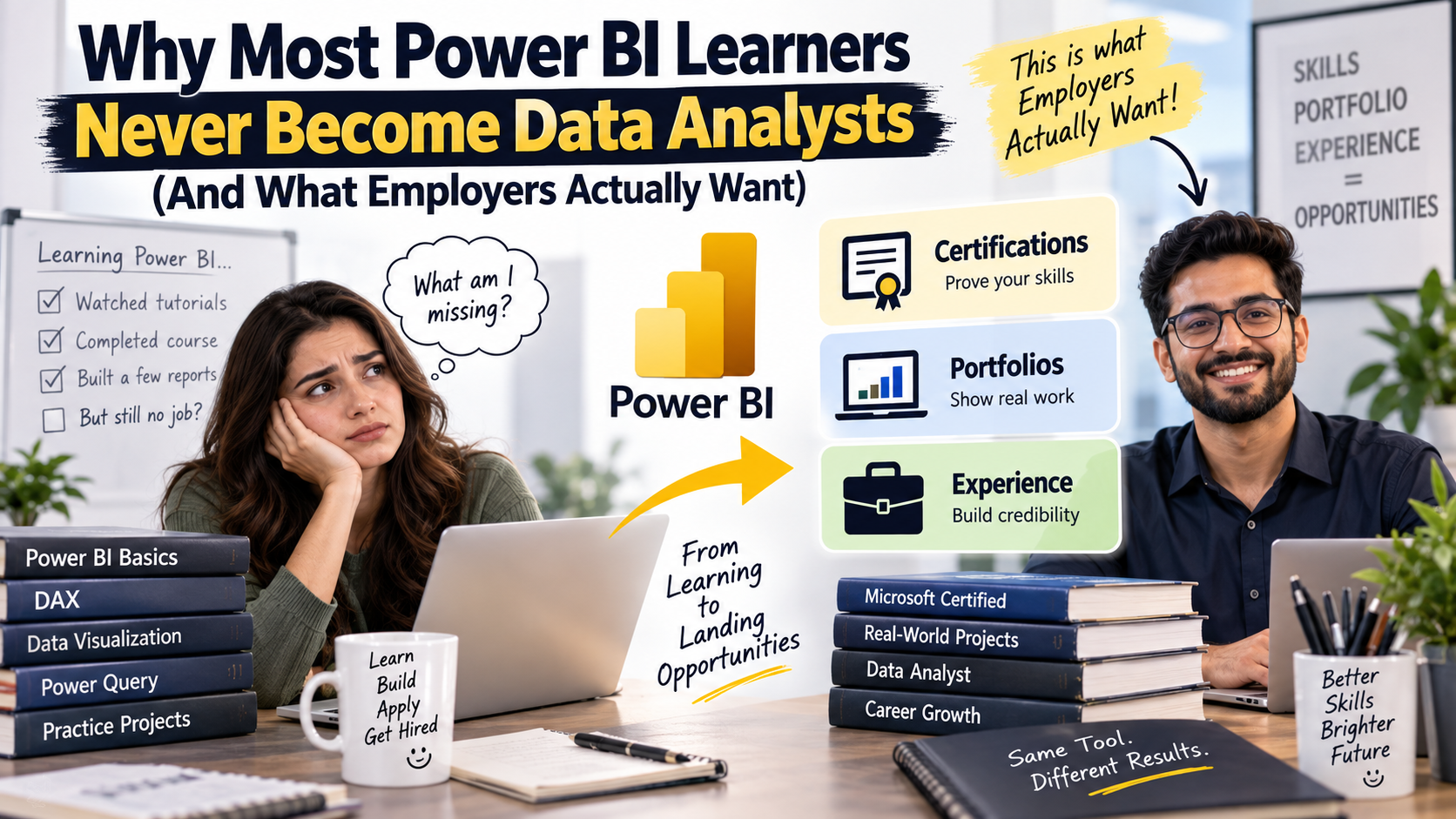
Learners often ask which one matters most. The honest answer is that they each do a different job:
| What you show | What an employer hears |
| Course certificate | “Finished training.” Positive, but nearly every applicant has one. |
| PL-300 certification | “Meets a recognised Microsoft standard for modelling, DAX and reporting.” |
| Portfolio project with a written business takeaway | “Can work independently and thinks like an analyst.” |
| Real experience (even volunteer or internal) | “Has handled messy data and real stakeholders.” |
| Clear interview stories | “Communicates well and learns from mistakes.” |
The strongest applications combine two or three of these. The PL-300 Microsoft Power BI Data Analyst course lines up with Microsoft’s Power BI Data Analyst Associate certification, which is useful evidence that you’ve met a recognised standard. Pair it with projects. Our posts on certifications versus real dashboard experience and portfolio projects that get interviews go into more detail.
No job yet to build experience? Create some. Volunteer for a not-for-profit, offer to tidy a friend’s business reporting, or automate something at your current workplace. That’s real experience, and it counts toward your goal to become a data analyst.
Interview Questions You Should Be Ready For
You’ll rarely be asked which menu a button lives in. Expect questions like these, and know what they’re really testing:
- “Walk me through a project you’re proud of.” Tests structure, and whether you start with the business problem.
- “How did you check your numbers were right?” Tests attention to data quality.
- “How would you explain a drop in sales to a non-technical manager?” Tests communication.
- “What’s the difference between a calculated column and a measure?” Tests modelling fundamentals.
- “Tell me about a time your analysis was wrong.” Tests honesty and learning.
- “How would you handle a stakeholder who keeps changing their mind?” Tests patience and scoping.
Rehearse two or three of these out loud. It feels silly, and it’s the fastest way to sound ready to become a data analyst on day one.
A 60-Day Plan to Become a Data Analyst That Employers Notice
You don’t need another six months of courses. You need focus. Here’s a realistic sequence:
- Week 1: Audit yourself. List what you can do in Power BI, SQL and data cleaning. Be honest, then pick your weakest area.
- Weeks 2 to 3: Fix the foundations. Practise data modelling and DAX. If you want structure, start with the Beginner or Intermediate course.
- Weeks 4 to 5: Build one real project. Choose a messy, unusual dataset that interests you. Write the business question first and record every cleaning decision.
- Week 6: Add basic SQL. Query a real database and connect it to Power BI.
- Week 7: Write it up. Turn the project into a short case study covering the problem, approach, result and what you’d do next.
- Week 8: Apply and rehearse. Send applications, practise your interview answers and ask for feedback on every rejection.
Do that and you’ll have answers to almost every question employers ask. It’s a practical way to become a data analyst without waiting for the perfect moment.
Where to Train If You Want to Become a Data Analyst in Australia
Location matters less than it used to, but it still helps to know your options. Power BI Course runs training across the country:
- Melbourne: Power BI course in Melbourne, in-person at West Melbourne or live online.
- Sydney: Power BI course in Sydney, in-person at Surry Hills or live online.
- Brisbane: Power BI course in Brisbane, in-person in Brisbane City or live online.
- Perth: Power BI courses in Perth, live online or in-house.
- Adelaide: Power BI course in Adelaide, live online or in-house.
- Canberra: Power BI course in Canberra, live online or in-house.
You can see every option on the Power BI course locations page, and teams can arrange tailored onsite or virtual training. To see how data roles fit into the wider job market, Jobs and Skills Australia publishes occupation and skills research, and the Australian Computer Society is a useful place for professional development and industry connections. For pay expectations, see our Power BI salary guide.
Ready to Become a Data Analyst? Choose Your Next Step
Not sure where to begin? Here’s a simple pathway using the courses at Power BI Course:
- New to Power BI: start with the Power BI Beginner course for Power Query, your first dashboard and sharing reports.
- Comfortable with the basics: the Intermediate course adds DAX, drill-through and row-level security.
- Ready to go deeper: the Advanced course covers complex DAX, model optimisation and Python and R visuals.
- Going for certification: the PL-300 course is aligned to Microsoft’s Power BI Data Analyst exam.
- Curious about the wider Microsoft stack: try Introduction to Microsoft Power Platform (PL-900) or the DP-600 Fabric course above.
Every course uses real Australian datasets, and you keep a direct line to your trainer for 90 days afterwards. Browse all Power BI courses, read the FAQ, or call 1300 649 299 to talk it through. If you’re weighing up the wider career, our Power BI career opportunities guide and Power BI is the new Excel are good next reads.
FAQs About How to Become a Data Analyst
Can I become a data analyst with just Power BI skills?
It’s possible to become a data analyst this way, but uncommon. Power BI is a great foundation, yet most employers also expect basic SQL, sound data modelling and clear communication. Pair the tool with a real project and you’ll stand out.
How long does it take to become a data analyst in Australia?
It depends on your starting point, but many career changers plan for several months of focused study and project work. A structured 60-day push can make your portfolio interview-ready. The job search itself takes extra time.
Do I need a degree to become a data analyst?
Some employers list a degree, while others care more about demonstrated skills and projects. Check the job ads you’re targeting, and use a portfolio and certification to strengthen your case either way.
Is the PL-300 worth it?
For many learners, yes. It shows you’ve met a recognised Microsoft standard, and preparing for it builds real modelling and DAX skills. It works best alongside a portfolio project, not instead of one.
Should I learn SQL or Python first?
For most Power BI-focused roles, start with SQL. It tends to appear more often in junior analyst job ads and pairs naturally with Power BI. Python can come later.
What do employers look for in a junior data analyst?
Curiosity, clean and trustworthy data work, solid modelling, clear communication and a habit of starting with the business question. Tool skills matter, but they’re the entry ticket, not the whole story.
Final Thoughts: The Gap Is Smaller Than It Looks
Most Power BI learners don’t fail because they lack talent. They stall because nobody showed them how hiring actually works. Now you know. Start with the question, protect the data, build one real project and practise explaining it. That’s how you become a data analyst in the real world, one demonstrable skill at a time.
Ready for the next step? Explore our Power BI courses or send us an enquiry and we’ll help you choose the right level.