


The KPI ownership gap is the moment in a meeting when someone asks, “Who owns this number?” and the room goes quiet. The dashboard is polished, the data refreshes on schedule, and the figure on screen looks wrong. Yet nobody can say who should investigate, who can approve a fix, or who answers for it if the number is still wrong next month.
Thank you for reading this post, don't forget to subscribe!This guide explains why the KPI ownership gap is so common in Power BI environments, what it costs, and how to close it with clear roles, simple documentation and the right skills. If your reports are trusted on good days and blamed on bad ones, you are in the right place.
What Is the KPI Ownership Gap?
A key performance indicator only drives action when someone is accountable for it. The KPI ownership gap is the absence of that accountability: the metric exists, people use it, but no named person is responsible for its accuracy, meaning and upkeep.
It is different from a disagreement about definitions. Here, everyone might agree on the formula, yet nobody is on the hook when the data feed breaks, the logic needs to change or the number drifts away from reality. The metric belongs to everybody, which in practice means it belongs to nobody.
Why the KPI Ownership Gap Happens
Few organisations choose to leave metrics unowned. The gap appears because of how reporting grows:
- The builder becomes the default owner. Whoever created the report is assumed to be responsible, even after they change roles or the business changes direction.
- The number crosses teams. A KPI may rely on sales data, finance adjustments and operational feeds, so no single department feels it is theirs.
- Reports multiply. Copies and variations spread across workspaces, and each one inherits a vague sense of ownership.
- Restructures reset responsibility. When teams reorganise, metric ownership rarely moves with the people.
- Ownership is assumed, not recorded. Everyone believes someone else has it covered.
Signs of a KPI Ownership Gap in Your Power BI Reports
You can usually spot the gap by listening to how people talk about the data:
- “I think that comes from the old report, but I am not sure who built it.”
- Questions about a number bounce between finance, IT and the business with no clear answer.
- Fixes take weeks because nobody has authority to approve a change.
- The same KPI appears in several reports, and nobody knows which one is official.
- Report authors have left, but their workspaces and refresh schedules are still running.
- Leaders ask for a “manual check” before trusting any important figure.
The Real Cost of the KPI Ownership Gap
A wide KPI ownership gap quietly taxes the whole organisation.
- Slow response to errors. Every incident starts with a hunt for the right person instead of a fix.
- Blame instead of learning. With no owner, problems turn into finger-pointing.
- Stale measures. Business rules change, but unowned KPIs keep running on old logic.
- Lost confidence. Executives learn to distrust dashboards and rely on side spreadsheets.
- Wasted analyst time. Analysts spend hours defending numbers they were never asked to own.
Our article on dashboard ownership shows how the KPI ownership gap looks at report level, and the dashboard graveyard post explains why unowned reports tend to fade away unused.
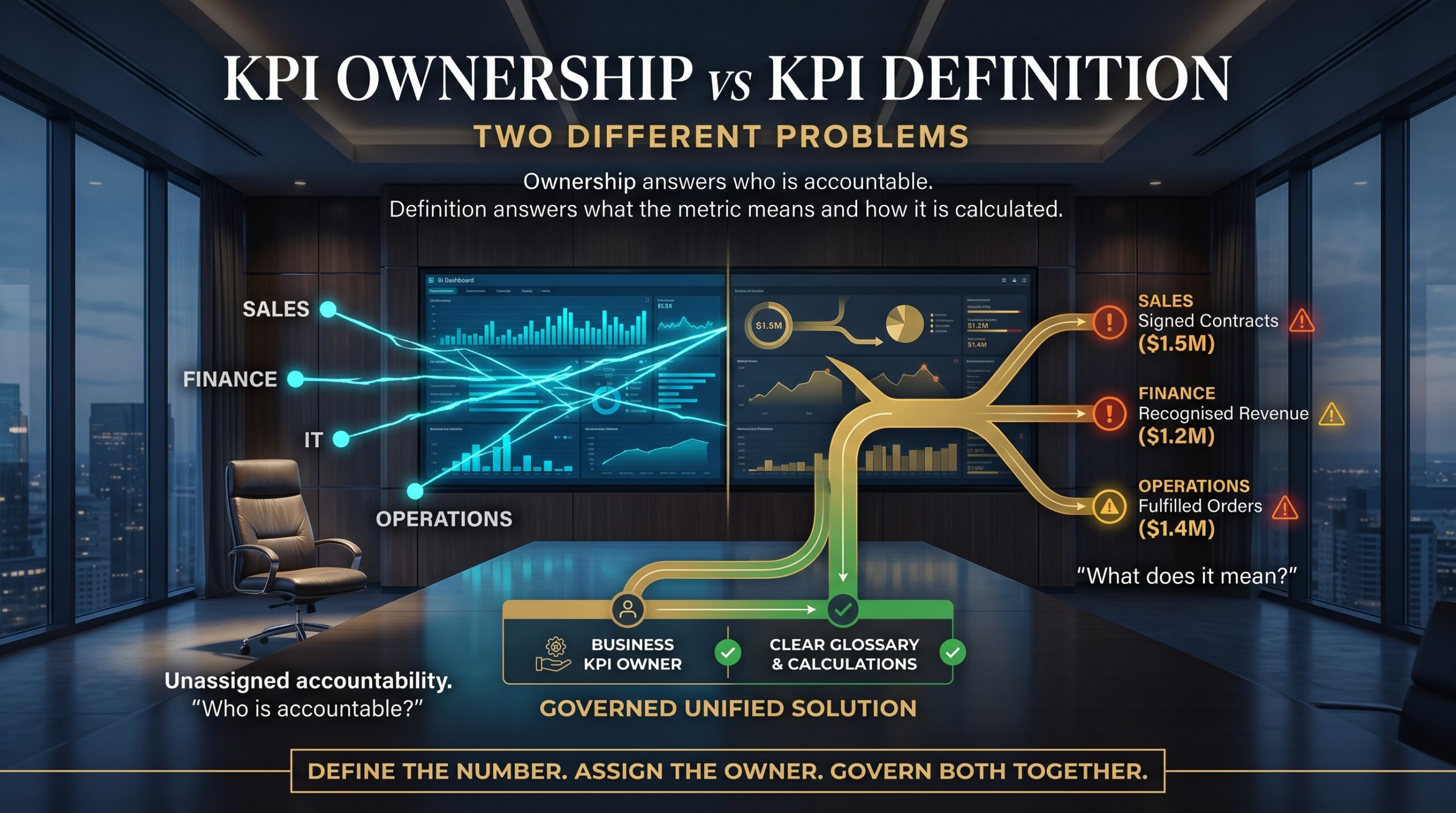
KPI Ownership vs KPI Definition: Two Different Problems
It helps to separate the two. A shared definition answers “what does this number mean?” Ownership answers “who is accountable for it?” You can have one without the other, and both are needed. If teams also disagree on formulas, start with our guide to the KPI definition gap. If the same KPI is calculated in several places, the measure sprawl problem is worth a read.
Who Should Own a KPI?
Ownership works best when it is split into a few clear roles instead of loaded onto one person. A simple model looks like this:
| Role | Responsible for |
| Executive sponsor | Agrees why the KPI matters and backs decisions about changing it. |
| Business owner | Accountable for what the number means and the actions taken from it. |
| Data steward | Checks data quality, definitions and source systems behind the KPI. |
| Report developer | Builds and maintains the measure and the visuals in Power BI. |
| Consumers | Use the KPI and raise questions through the agreed channel. |
A responsibility assignment matrix, often called RACI, is a handy way to record who is responsible, accountable, consulted and informed for each KPI. The business owner should be a person who can act on the number, not just the person who can build it.
How to Close the KPI Ownership Gap in Power BI
- Start with your top ten KPIs. Choose the metrics that appear in leadership packs, board reports or performance reviews.
- Create a KPI register. One shared list with the name, definition, source, owner and review date for each metric.
- Name one accountable owner per KPI. Shared accountability sounds fair but usually leaves the gap open.
- Match ownership to Power BI roles. Use workspace roles carefully so the people who maintain a model have the right access and the wrong people do not.
- Use one trusted model. Build important KPIs once in a shared semantic model and have reports connect to it. Power BI’s endorsement features, which let you promote or certify content, help users see which version to trust. The Power BI documentation explains how.
- Write the owner into the report. Add the owner’s name, contact channel and last review date to the report page or the measure description.
- Agree a change process. Decide who approves changes to a KPI and how users are told.
- Review on a schedule. Check ownership every quarter and after every restructure.
This sits inside the wider field of data governance, but you do not need a large programme to start. A short register and a few honest conversations will close most of the KPI ownership gap.
A Simple KPI Ownership Card
For each important KPI, keep a short card that anyone can find. It should answer these questions:
- What is the KPI called, and why does it matter?
- Who is the business owner, and who is their backup?
- Where does the data come from, and who maintains that source?
- Which Power BI report or model is the official version?
- How and when is it reviewed, and how are changes communicated?
If a person can answer all five questions in under a minute, you have closed the KPI ownership gap for that metric. If they cannot, you have found where to start.
Mistakes That Keep the KPI Ownership Gap Open
- Naming a team or committee as the owner instead of a named person.
- Treating the report builder as the permanent owner of the business meaning.
- Recording ownership once in a document that nobody updates.
- Giving owners responsibility without the authority or time to act.
- Waiting for a major incident before agreeing who is accountable.
Power BI Skills That Make Ownership Easier
Clear roles are the foundation, but owners and developers also need the skills to keep KPIs accurate and well documented. These courses cover the practical side:
- Power BI Beginner Course covers connecting, transforming and sharing data with Power Query.
- Power BI Intermediate Course teaches DAX, drill-through pages, row-level security and governance.
- Power BI Advanced Course focuses on complex DAX and optimising enterprise data models.
- PL-300 Microsoft Power BI Data Analyst prepares you for the Microsoft certification exam.
- Introduction to Microsoft Power Platform (PL-900) gives business users a wider view of the platform.
- DP-600T00 Microsoft Fabric Analytics Engineer suits teams building enterprise analytics solutions.
See every option on our Power BI courses page, read the FAQ or find more practical articles on the Power BI blog.
Learn Power BI in Your City
Whether your team is in the middle of a KPI ownership gap or simply wants stronger reporting skills, training is available in person and live online:
- Power BI course in Melbourne
- Power BI course in Sydney
- Power BI course in Brisbane
- Power BI courses in Perth
- Power BI course in Adelaide
- Power BI course in Canberra
In-person classes run in Melbourne, Sydney and Brisbane, while Perth, Adelaide and Canberra learners can join live online or arrange in-house delivery. Not sure which course fits? Contact our team for advice.
Frequently Asked Questions About the KPI Ownership Gap
What is the KPI ownership gap?
It is the lack of a named, accountable person for a KPI. The metric is widely used, but nobody is responsible for its accuracy, changes or upkeep.
Who should own a KPI in a business?
A business leader who can act on the number should own it. A data steward and a report developer support them with data quality and the technical build.
How do you assign KPI owners in Power BI?
Create a KPI register with one named owner per metric, show that owner on the report, and align workspace roles and model maintenance with those responsibilities.
What is the difference between a KPI owner and a report owner?
The KPI owner is accountable for what the number means and what is done about it. The report owner maintains the visuals and the technical build in Power BI.
How often should KPI ownership be reviewed?
At least every quarter, and whenever there is a restructure, a system change or a major shift in business goals.
Final Thoughts
The KPI ownership gap is not a technical fault, and a better visual will not fix it. It is a gap in accountability. When every important number has a named owner, a clear home and a regular review, questions get answered faster and leaders trust the data more.
Ready to build the skills behind reliable reporting? Explore our Power BI courses and help your team turn dashboards into numbers people can stand behind.