


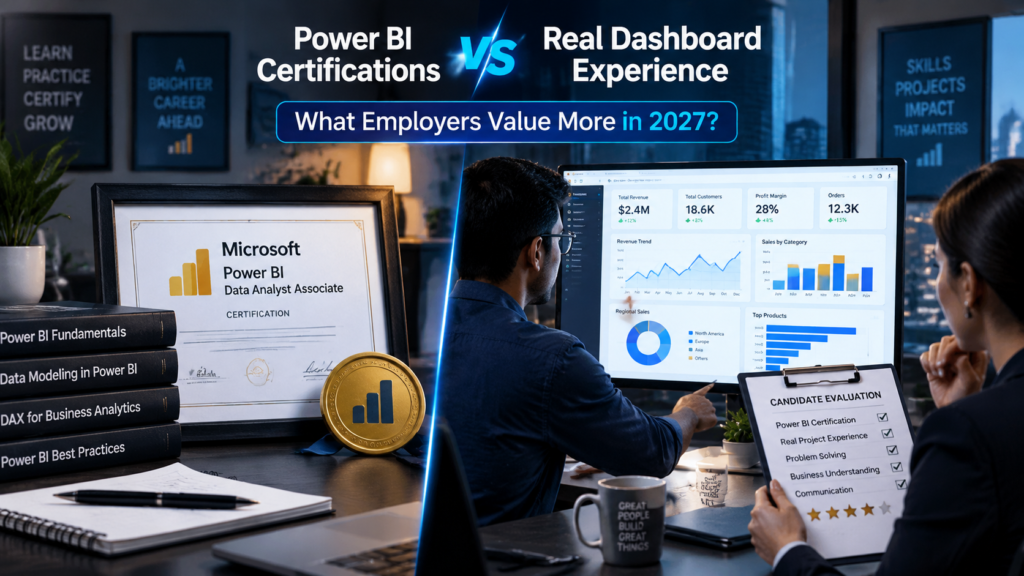
Power BI certification vs experience is one of the most debated questions among job seekers heading into 2027, and Australian employers don’t give a single straight answer because the truth sits in the middle. A PL-300 certification tells a hiring manager you understand Power BI’s structure and best practices. A portfolio of real dashboards tells them you can actually apply that knowledge to messy, real business data. The candidates who get hired fastest in Sydney, Melbourne, Brisbane, Perth, Adelaide and Canberra in 2027 are rarely the ones with just one or the other they’re the ones who can point to both.
Thank you for reading this post, don't forget to subscribe!This guide breaks down exactly what Power BI certification proves, what real dashboard experience proves, where employers place the most weight, and how to build both so you’re not stuck choosing one over the other.
What a Power BI Certification Actually Proves
The Microsoft PL-300: Power BI Data Analyst certification verifies that a candidate understands the structured fundamentals of Power BI data modelling, DAX, Power Query, and report design principles in a controlled exam environment. For hiring managers, it’s a fast, low-risk signal: someone with a current PL-300 is unlikely to be starting completely from zero.
What certification proves well
- Structured understanding of data modelling and star schema design
- DAX fundamentals and common function usage
- Awareness of Power BI Service, workspaces, and governance basics
- A baseline that’s consistent and comparable across every candidate
What certification does not prove
- Whether you can clean genuinely messy, inconsistent business data
- Whether you can design a dashboard a non-technical stakeholder actually understands
- Whether you can defend your modelling choices under real business constraints
- Communication and stakeholder management skills
What Real Dashboard Experience Actually Proves
A documented Power BI portfolio even from practice datasets demonstrates something an exam simply can’t: judgment. Building a dashboard from raw, messy data forces decisions a multiple-choice exam never tests, like which visuals actually communicate the insight, how to structure a data model for performance, and when a DAX measure needs to be rewritten because business users misread it. Hiring managers in Melbourne and Sydney increasingly ask candidates to walk through a real dashboard during interviews for exactly this reason it reveals reasoning, not memorisation.
What a strong Power BI portfolio needs
- At least one dashboard built from a messy or semi-structured dataset, not a clean tutorial file
- Visible data modelling decisions relationships, star schema, calculated columns vs measures
- A short write-up of the business question the dashboard answers
- At least one DAX measure you can explain in plain English, not just show
- Evidence of iteration an earlier version and what you changed, and why
Head-to-Head: Certification vs Experience
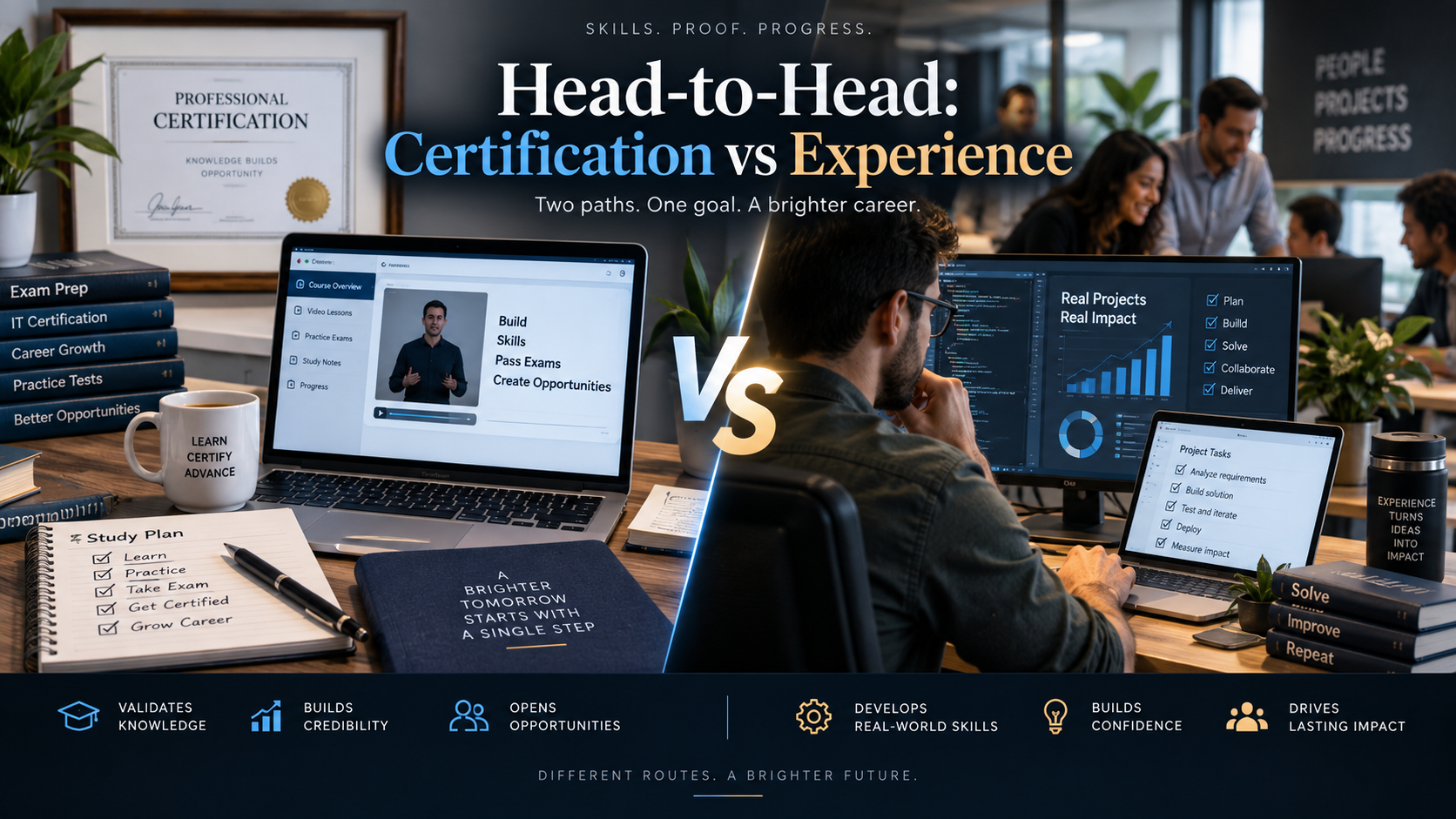
| Factor | Power BI Certification | Real Dashboard Experience |
| Proves structured knowledge | Yes verified by exam | Not directly, but implied through execution |
| Proves applied judgment | Limited | Yes visible in modelling & design choices |
| Fast to verify by employer | Yes certificate number/badge | Slower requires a portfolio review or live walkthrough |
| Useful for entry-level roles | Very useful reduces perceived risk | Highly valuable, but harder to build without any role yet |
| Useful for career changers | Strong signal of commitment | Essential closes the “no industry experience” gap |
| Weight in live interviews | Opens the door | Usually decides the outcome |
What Australian Employers Say They Actually Value More in 2027
Feedback from hiring managers across Brisbane, Perth, Adelaide and Canberra points to a consistent pattern heading into 2027: certification gets a candidate shortlisted, but a real, explainable dashboard is what gets the offer. Employers increasingly ask candidates to share a screen and talk through their own Power BI work during interviews a request that a certification alone cannot prepare you for, but that structured, project-based training can.
This is exactly the gap the Power BI course at powerbicourse.au is built to close pairing PL-300-aligned certification content with genuine, portfolio-ready dashboard projects, rather than treating the exam as the finish line.
The Smartest Path: Combine Both, in the Right Order
Rather than treating certification and experience as competing choices, the fastest route to being hired in 2027 combines them deliberately: use certification to build the structured foundation, then immediately apply it to real, messy datasets so the knowledge becomes demonstrable rather than theoretical.
A practical 4-step sequence
- Learn the fundamentals data modelling, DAX, Power Query through structured training
- Sit the PL-300 certification to validate and formalise that knowledge
- Immediately apply it to 2–3 real or realistic datasets and document the process
- Practise explaining your dashboard decisions out loud, the way an interviewer will ask you to
For candidates who also want to strengthen the data side of this pairing, the Data Analytics course at dataanalyticscourses.au builds the SQL and data-cleaning skills that make Power BI dashboards genuinely reflect messy, real-world data rather than pre-cleaned tutorial files.
Frequently Asked Questions
Is Power BI certification worth it if I already have dashboard experience?
Yes certification formalises and verifies knowledge that experience alone can’t prove to a stranger reading your resume. It’s especially valuable for passing automated resume screening and recruiter shortlisting.
Can I get a Power BI job with only a certification and no portfolio?
It’s possible for some entry-level roles, but increasingly unlikely for competitive roles in 2027, since more Australian employers now ask candidates to walk through real dashboard work during interviews.
What matters more in a Power BI job interview: certification or a portfolio?
A portfolio almost always carries more weight in the interview itself, because it demonstrates applied judgment. Certification matters most earlier in the process, for getting shortlisted in the first place.
Final Thoughts
Power BI certification vs experience isn’t really an either-or decision for candidates hoping to get hired in Sydney, Melbourne, Brisbane, Perth, Adelaide and Canberra in 2027 it’s a sequencing question. Certification opens the door and proves structured knowledge fast; a real, explainable dashboard portfolio is what closes the interview. The candidates who invest in both, in the right order, are consistently the ones who get hired first.
To build both together, Logitrain offers structured PL-300-aligned training, and the powerbicourse.au and dataanalyticscourses.au microsites are built specifically around producing portfolio-ready dashboards, not just exam prep.