



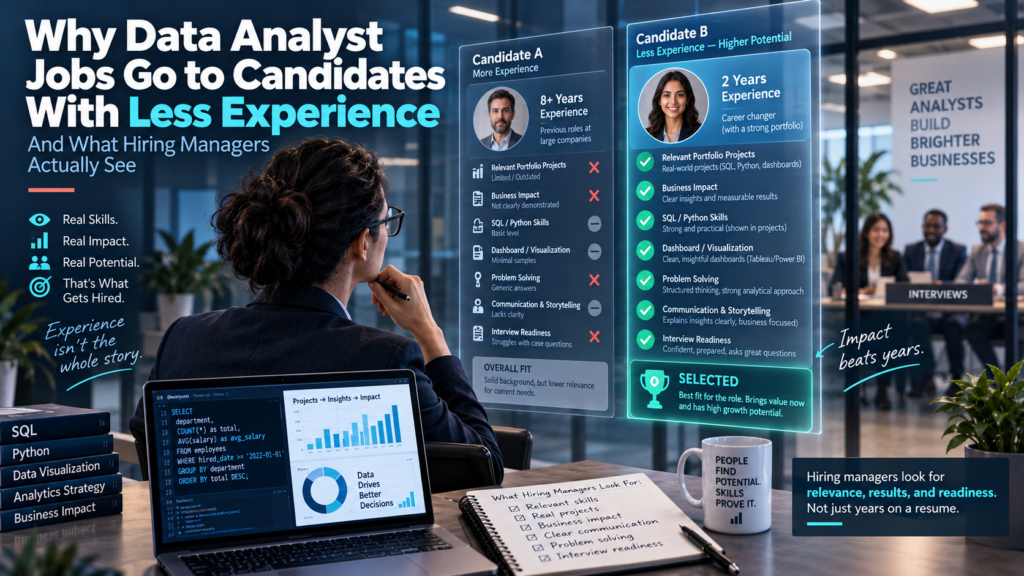
Why less experienced candidates get hired ahead of applicants with more years on their resume is one of the most frustrating patterns in Australia’s data analyst job market and once you understand what hiring managers are actually looking for, it stops being a mystery. Across Sydney, Melbourne, Brisbane, Perth, Adelaide and Canberra, recruiters routinely shortlist a candidate with 18 months of experience and a strong Power BI portfolio over a candidate with five years in a role that never touched modern analytics tools. Years alone were never the criterion. Demonstrated, current, visible skill is.
Thank you for reading this post, don't forget to subscribe!Why Less Experienced Candidates Get Hired: The Real Reason
Hiring managers are not comparing years of experience they are comparing evidence of ability. A junior candidate who can walk into an interview with a live Power BI dashboard, explain the DAX behind it, and describe the business decision it supported gives a hiring manager something concrete to evaluate. A senior candidate who describes years of “reporting responsibilities” in vague terms gives them nothing to verify. This is why less experienced candidates get hired more often than their resumes would predict they simply make their skill visible.
What Hiring Managers Actually See When They Compare Candidates
1. Recent, Relevant Tools Beat Years of Outdated Ones
A candidate who spent five years exporting static reports from legacy systems is not automatically more valuable than a candidate with 18 months of hands-on Power BI, DAX and Power Query experience. Employers in Sydney and Melbourne are hiring for today’s tool stack, not yesterday’s job title. This is a major reason why less experienced candidates get hired over senior applicants whose skills didn’t keep pace with the tools.
2. A Portfolio Proves What a Resume Only Claims
Anyone can write “data analysis and reporting” on a resume. Very few candidates attach a working dashboard, a GitHub link, or a short case study showing the problem, the approach and the business outcome. When a less experienced candidate has this and a senior candidate does not, the decision becomes easy for the hiring manager.
3. Confidence Explaining the “Why” Matters More Than Tenure
In interviews across Brisbane and Perth, hiring managers consistently rank a candidate’s ability to explain why a metric changed not just report that it did above years of experience. Less experienced candidates who have practised this specific skill routinely out-interview senior applicants who have never had to defend an insight in front of a stakeholder.
4. Certifications Signal Current, Verifiable Skill
A recognised, recent certification such as PL-300 tells a hiring manager exactly what a candidate can do, verified by an external body something a vague job title from five years ago cannot do. This is one of the fastest, most fixable reasons why less experienced candidates get hired: they hold a credential that removes doubt.
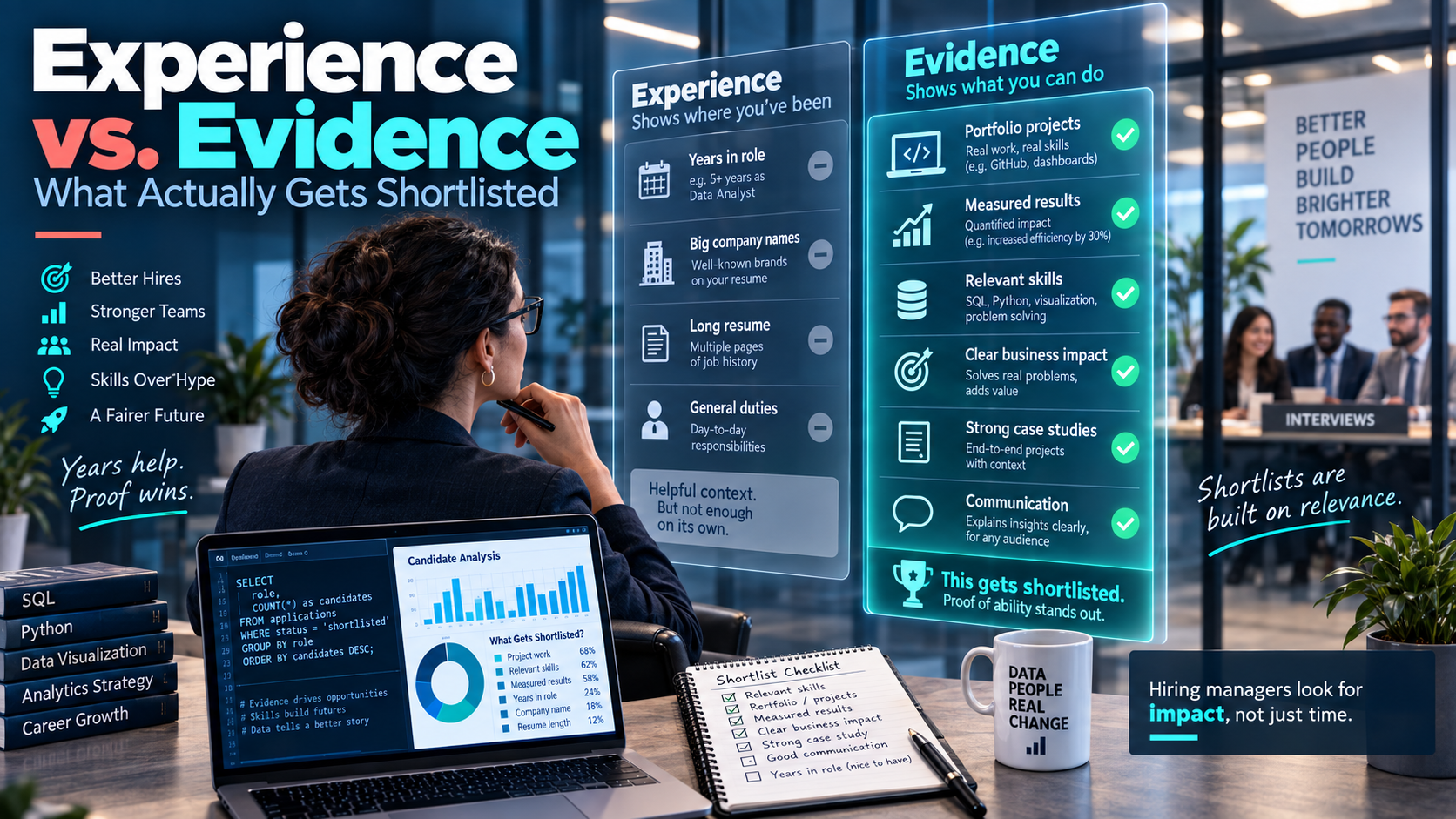
Experience vs. Evidence: What Actually Gets Shortlisted
| Years of Experience Alone | What Actually Gets a Candidate Hired |
| “5 years in reporting and analysis” on a resume | A live Power BI dashboard link candidates can walk through in the interview |
| Legacy tools (static Excel exports, manual reports) | Current tools: Power BI, DAX, Power Query, SQL |
| General job-title responsibilities | A specific project with a measurable business outcome |
| No certification, or one that’s several years outdated | A current, recognised credential such as PL-300 |
| Struggles to explain “why” a number changed | Can confidently walk through cause, impact and recommendation |
City-by-City: Where This Pattern Shows Up Most
Why less experienced candidates get hired varies slightly by city, but the underlying pattern holds everywhere. In Sydney and Melbourne, the volume of applicants means hiring managers default to whoever can prove skill fastest usually the candidate with a visible portfolio. In Brisbane and Perth, where analytics roles increasingly sit inside operations and resources teams, practical dashboard experience beats theoretical years of tenure. In Adelaide and Canberra, government and public-sector panels weigh recent, verifiable certification heavily, which again tends to favour candidates who trained recently over those relying on older experience.
How to Compete When You Have Less Experience
- Build one real Power BI dashboard from messy, multi-source data not a tutorial dataset and be ready to walk through it.
- Earn a current, recognised certification such as PL-300 to remove doubt about your skill level.
- Practise explaining the business “why” behind a metric, not just the technical “how” you built it.
- Keep your tool stack current Power BI, DAX, Power Query and SQL over legacy reporting tools.
- Lead your resume and interview with outcomes, not years what changed because of your analysis.
Build the exact skill set hiring managers are shortlisting for with the Power BI Course, covering DAX, data modelling and dashboard design from real business scenarios.
To round out the analytical foundation behind the dashboard, the Data Analytics Courses pathway adds the SQL and data-analysis skills recruiters look for alongside Power BI.
Both programs are delivered by Logitrain, Australia’s long-established IT training provider, with instructor-led classes across every major city.
What Australian Hiring Data Confirms
This shift toward skill-based hiring over pure tenure is well documented Seek’s Data Analyst career guide tracks the tools, certifications and skills Australian employers are actually asking for in current job ads.
The data backs up what hiring managers say anecdotally: demonstrated, current skill consistently outperforms undemonstrated tenure. This is exactly why less experienced candidates get hired at the rate they do they are simply easier to evaluate with confidence.
Closing Thoughts on Why Less Experienced Candidates Get Hired
Why less experienced candidates get hired ahead of more tenured applicants comes down to one thing: visible, current, provable skill beats an unverified number of years every time. Candidates in Sydney, Melbourne, Brisbane, Perth, Adelaide and Canberra who build a real portfolio project, hold a current certification, and can explain the business impact of their work consistently out-compete senior applicants who rely on tenure alone. Experience still matters but only once it is demonstrated, not just claimed.