




If you’re weighing up PL-300 certification in Australia as your next career move, you’re considering one of the most actively recruited data credentials in the country right now. But is it genuinely worth the study time. This guide breaks down exactly what PL-300 tests, which jobs it opens up, real salary data, and where to train across Sydney, Melbourne, Brisbane, Perth, Adelaide, and Canberra.
Thank you for reading this post, don't forget to subscribe!What Is the PL-300 Power BI Certification?
PL-300, officially Microsoft Certified: Power BI Data Analyst Associate, validates your ability to prepare, model, visualise, and analyse data using Power BI, along with managing and securing Power BI assets. The exam runs 100 minutes, requires a pass score of 700, costs approximately AUD $230 in Australia, and the credential is valid for one year, renewable for free through a shorter online assessment. It replaced the older DA-100 exam and remains Microsoft’s flagship Power BI credential.
Why Power BI Skills Are in Demand in Australia
Power BI has become the default reporting tool across Australian banking, government, healthcare, and retail organisations. A scan of Power BI job listings on Seek shows steady demand for data analyst, reporting analyst, and Power BI developer roles nationwide, with certified professionals commonly earning a documented salary premium over non-certified peers in equivalent positions.
Is PL-300 Worth It for Data Analyst Jobs?
For most beginners and early-career analysts, yes. PL-300 acts as an ATS screening filter that gets your resume in front of a human reviewer, and it’s increasingly listed as a required or preferred qualification for data analyst and BI roles. The honest caveat: certification alone won’t land you a senior role — it delivers the most value when paired with genuine hands-on project experience, since employers consistently look for a portfolio alongside the credential.
What Skills Does PL-300 Validate?
PL-300 covers the full Power BI workflow across four core domains:
Preparing Data with Power Query
Connecting to data sources and cleaning, transforming, and shaping raw data before it reaches a report.
Modelling Data in Power BI
Building efficient data models with correct relationships, hierarchies, and calculated tables.
Creating DAX Measures
Writing DAX formulas for aggregations, calculations, and time intelligence — widely considered the most challenging part of the exam.
Building Dashboards and Reports
Designing interactive, decision-ready reports and dashboards that tell a clear business story.
Visualising and Analysing Data
Using advanced analytics features like Q&A visuals, bookmarks, and drillthrough to deepen the analysis.
Managing and Securing Power BI Assets
Deploying reports, managing workspaces, and applying row-level security — the governance side of the role.
Power BI Certification Jobs in Australia
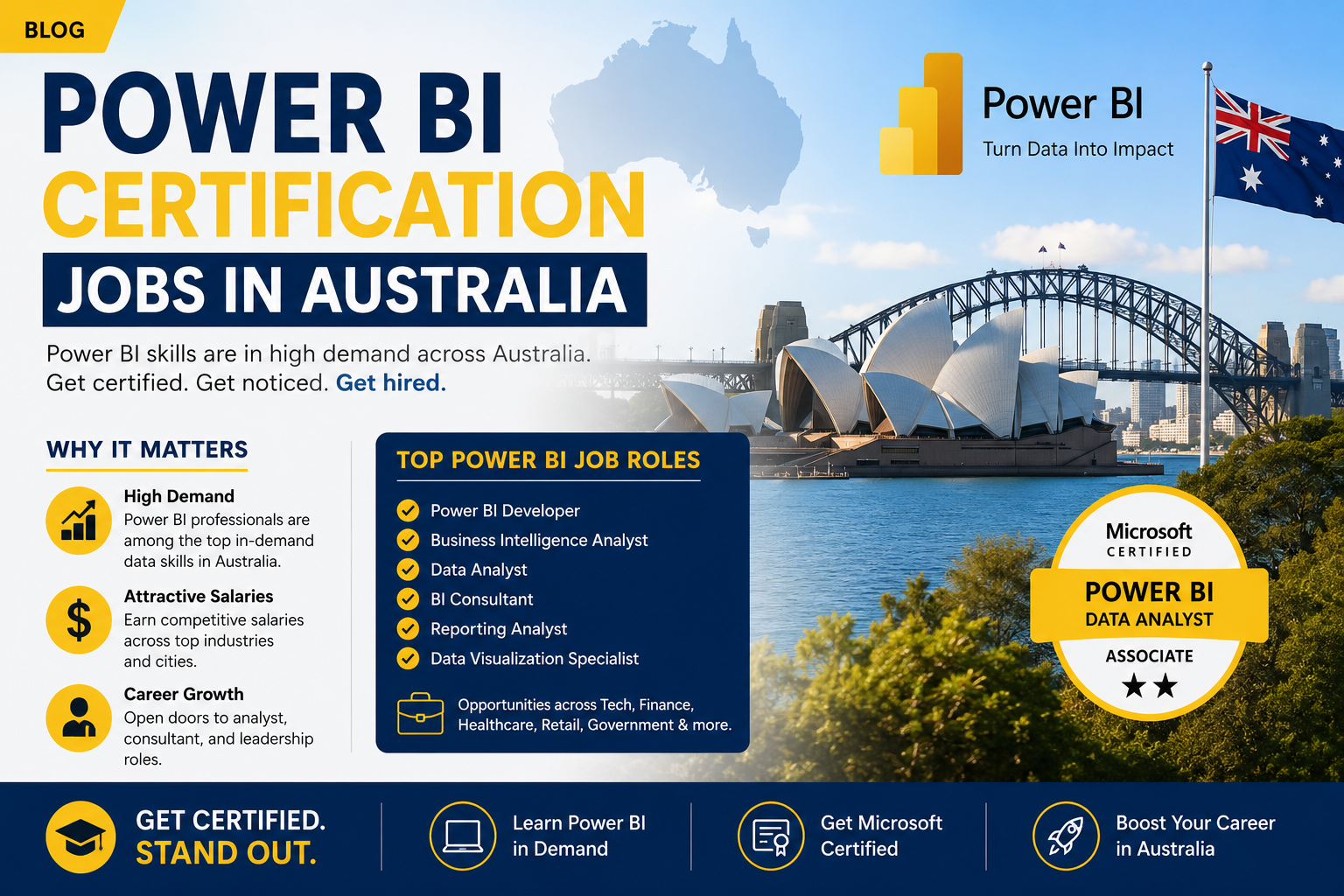
PL-300 appears consistently across job ads for data analyst, BI analyst, reporting analyst, and Power BI developer roles, spanning industries from banking and government through to retail and healthcare. Employers frequently pair it with SQL or Excel requirements, since Power BI rarely operates in isolation from the rest of the reporting pipeline.
Career Roles After PL-300 Certification
These are the roles PL-300 most commonly supports:
Data Analyst
A broad role using Power BI alongside SQL and Excel to pull, clean, and report on data for business decisions.
Power BI Analyst
Focused specifically on building and maintaining Power BI dashboards and reports across a business.
Reporting Analyst
Centred on maintaining recurring reports, often with less emphasis on complex data modelling than a full BI role.
Business Intelligence Analyst
A broader BI-focused role spanning data modelling, reporting, and stakeholder-facing dashboard delivery.
Power BI Developer
The most technical Power BI role, with heavy emphasis on DAX, data modelling, and increasingly Microsoft Fabric integration.
PL-300 vs Power BI Course: What Is the Difference?
A Power BI course teaches you the tool; PL-300 is the certification exam that validates what you’ve learned. Most learners take a structured Power BI course specifically to prepare for PL-300, since studying directly against Microsoft’s exam objectives keeps preparation focused rather than open-ended.
PL-300 vs Microsoft Fabric: Which Should You Learn First?
PL-300 first, in almost all cases. Microsoft Fabric is a broader data platform that Power BI now sits within, and understanding Power BI’s data modelling and reporting fundamentals through PL-300 makes Fabric significantly easier to pick up afterward, particularly for analysts moving toward Power BI Developer or Data Engineer roles.
PL-300 vs CompTIA Data+: Which Certification Is Better?
PL-300 is Power BI-specific and directly tool-focused, while CompTIA Data+ is a broader, vendor-neutral data analytics fundamentals certification. If your target roles specifically list Power BI, PL-300 is the stronger, more direct investment. If you’re not yet sure which BI tool you’ll end up using, Data+ offers broader foundational value.
Is PL-300 Good for Beginners?
PL-300 is not a true entry-level exam — it assumes solid working knowledge of Power Query and DAX rather than zero prior exposure. Complete beginners should spend some time building hands-on Power BI skills first, ideally through a structured course, before attempting the exam directly.
Do You Need SQL Before Learning Power BI?
Not strictly, but it helps significantly. Power BI can connect directly to SQL databases, and understanding how data is structured in SQL makes Power BI’s data modelling concepts click faster. Our guide to SQL for data analysts in Australia is a useful companion resource if you want to build that foundation first.
Do You Need Excel Before Learning Power BI?
Excel experience helps but isn’t mandatory. Many of Power BI’s data modelling and formula concepts (particularly DAX) echo Excel logic, so Excel users often find the transition to Power BI smoother than complete beginners do.
Power BI Certification for Career Changers
PL-300 is a strong, structured pathway for career changers moving into data analytics, since it gives you a clear curriculum to follow rather than randomly working through scattered tutorials. Pairing it with a small portfolio project significantly strengthens a career changer’s job applications.
Power BI Certification for Business Professionals
Business professionals in non-technical roles — marketing, operations, finance — increasingly pursue PL-300 to build self-service reporting skills, reducing reliance on IT teams to build every report and giving them a genuine data-driven edge in their existing role.
Power BI Certification for Data Analysts
For working data analysts, PL-300 formalises existing skills and is often the deciding factor when moving from a junior to a senior title, since many organisations now expect the certification before considering an internal promotion.
Power BI Certification in Sydney
Sydney’s concentration of banking and financial services employers drives strong demand for PL-300 certified analysts, particularly for roles supporting regulatory and executive reporting.
Power BI Certification in Melbourne
Melbourne’s broad, cross-industry employer base makes PL-300 a versatile credential, recognised across corporate, healthcare, and government reporting roles alike.
Power BI Certification in Brisbane
Brisbane’s growing government and infrastructure sector is increasingly requesting Power BI certification for reporting and BI analyst positions.
Power BI Certification in Perth
Perth’s resources sector values PL-300 certified analysts who can build operational and cost dashboards at scale for mining and energy employers.
Power BI Certification in Adelaide
Adelaide’s defence, health, and government sectors are steadily increasing demand for certified Power BI professionals for structured, governed reporting work.
Power BI Certification in Canberra
Canberra’s federal government roles frequently combine PL-300 with SQL or Microsoft Fabric requirements for large-scale, governed reporting environments.
Online Power BI Certification Training in Australia
Online Power BI training in Australia lets you prepare for PL-300 flexibly around a full-time job, and covers the same exam objectives as in-person courses. Look for a course that includes hands-on labs and mock exams rather than passive video content alone, since PL-300’s scenario-based questions reward applied practice.
How Long Does It Take to Prepare for PL-300?
Most candidates need eight to twelve weeks of focused study, at roughly one to two hours on weekdays and three to four hours on weekends, particularly if starting with limited prior Power BI experience. Candidates with six or more months of hands-on Power BI use can often prepare in four to six weeks.
Best Learning Path for Power BI and PL-300
Build Power Query and DAX fundamentals first, then progress through data modelling and dashboard design before attempting practice exams. For a deeper breakdown of exactly which Power BI skills Australian employers want, our guide on Power BI skills employers want in Australia covers this in more detail, and our dedicated PL-300 explainer walks through the exam structure and study plan step by step.
FAQs About Power BI Certification in Australia
Is PL-300 worth it in Australia?
Yes, for most beginners and early-career analysts. It’s a recognised, actively requested credential that improves your chances of getting shortlisted, especially when paired with real project experience.
Is Power BI enough to get a data analyst job?
Power BI alone is rarely enough — most data analyst roles also expect SQL and Excel skills alongside Power BI proficiency.
Is PL-300 hard for beginners?
It’s considered moderate difficulty, with DAX calculations and data modelling scenarios the most challenging sections, particularly for those without prior hands-on Power BI experience.
Do employers value Power BI certification?
Yes. PL-300 is increasingly listed as a required or preferred qualification across Australian data analyst and BI job ads, and it’s frequently used as a factor in junior-to-senior promotion decisions.
Should I learn Excel, SQL or Power BI first?
Excel first for foundational logic, then SQL to understand how data is structured, then Power BI to turn that data into dashboards — this order tends to make each stage easier to learn.
What jobs can I get with Power BI certification?
Data Analyst, Power BI Analyst, Reporting Analyst, Business Intelligence Analyst, and Power BI Developer are the most common roles PL-300 supports.
Start Your Power BI Certification Journey in Australia
PL-300 remains one of the strongest, most actively recruited data credentials available in Australia in 2026 — genuinely worth pursuing if you’re targeting data analyst, reporting, or BI roles, provided you back it up with real, hands-on project experience rather than treating it as a certificate to file away.
Want to become job-ready with Power BI and prepare for PL-300 certification?
Explore our Power BI and Data Analytics courses and build practical dashboard, reporting and data modelling skills for Australian workplaces.