


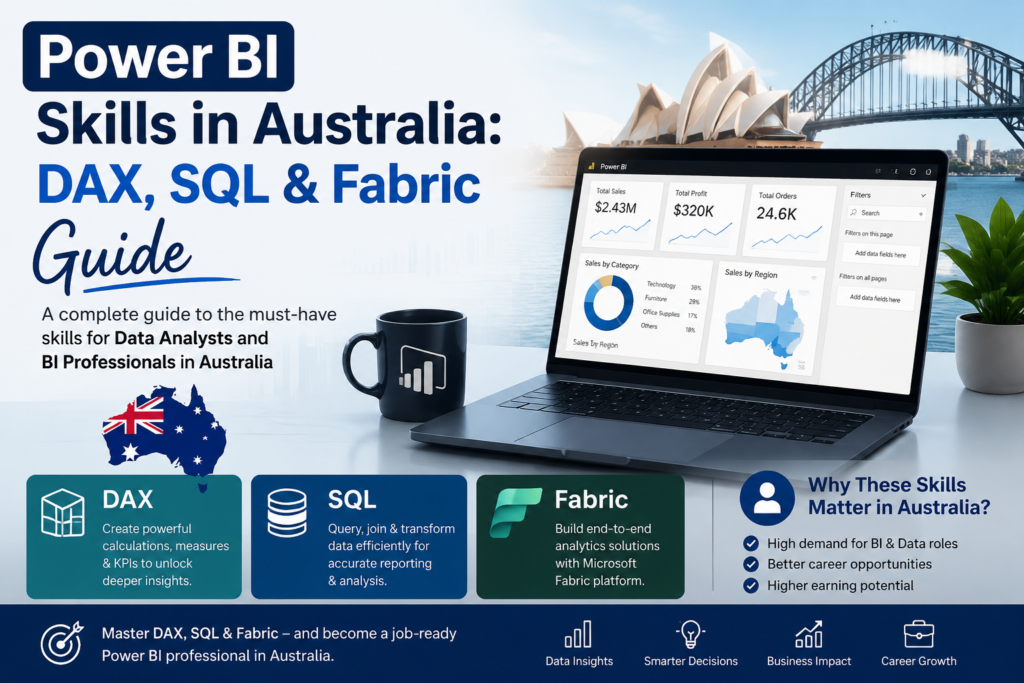
If you’re building Power BI skills for Australia job market in 2026, you’re chasing one of the most consistently in-demand tool sets in the country. Job ads rarely ask for Power BI on its own anymore — they pair it with SQL, DAX, data modelling, and increasingly Microsoft Fabric. This guide breaks down exactly which Power BI skills Australian employers are hiring for, how they map to different job titles, and where demand is strongest by city.
Thank you for reading this post, don't forget to subscribe!Why Power BI Skills Are in Demand in Australia
Power BI has become the default reporting tool across Australian banking, government, healthcare, and retail organisations, and demand shows no sign of slowing. A scan of current Power BI roles on Seek shows dashboard, developer, and analyst positions advertised nationwide, with hybrid Power BI Developer roles regularly listing salaries in the $120,000 to $140,000 range once experience and specialised skills like DAX and Fabric are added. For entry-level analysts, even foundational Power BI ability paired with Excel and SQL noticeably widens the roles you’re eligible for.
Core Power BI Skills Australian Employers Look For
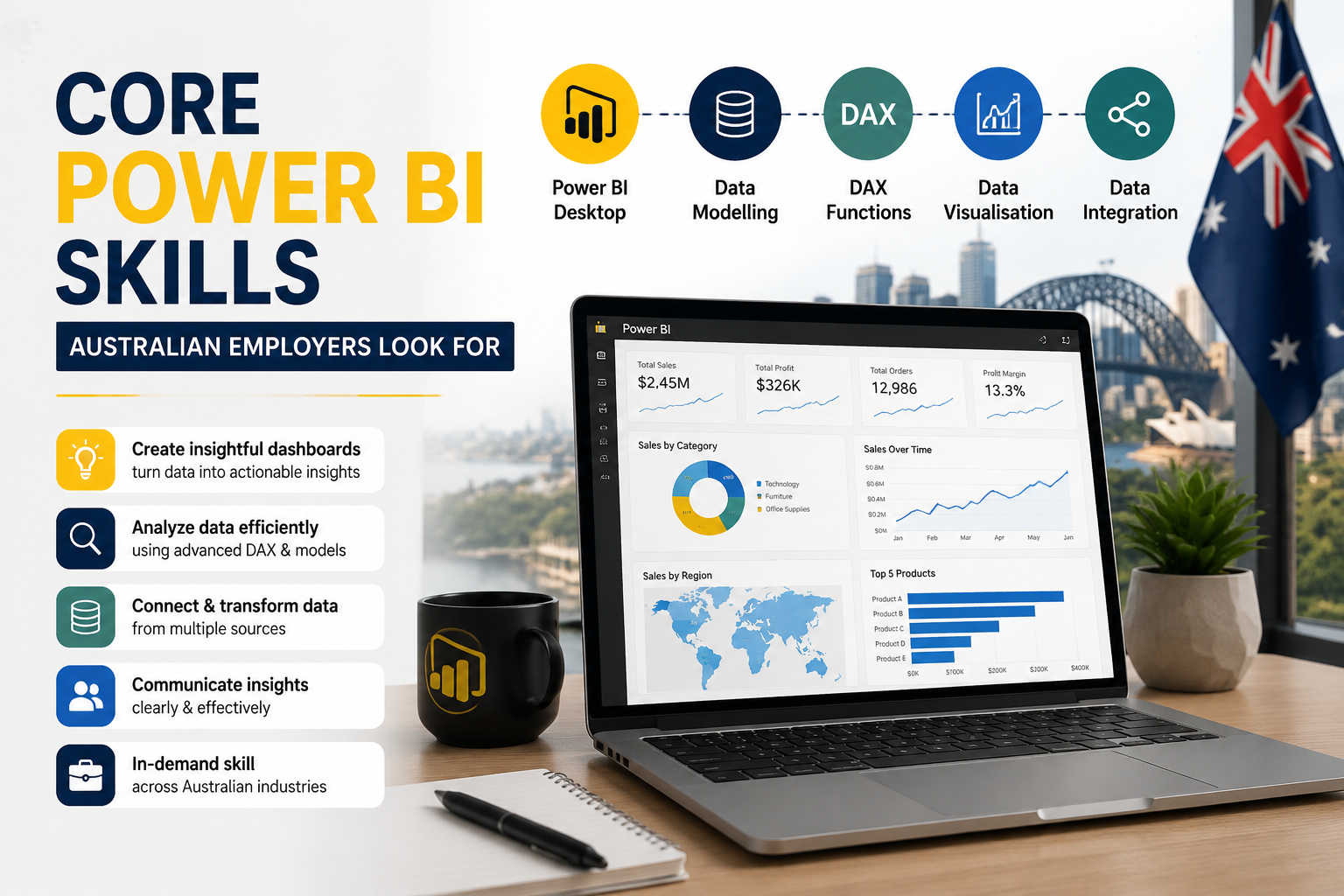
These are the skills that show up again and again across Australian Power BI job ads:
Dashboard Design
Building clear, decision-ready visuals rather than cluttered charts — this is often the first thing hiring managers judge in a portfolio.
Data Modelling
Structuring relationships between tables correctly so reports stay fast, accurate, and easy to maintain as data grows.
Power Query
Cleaning and transforming raw data before it reaches a report — removing duplicates, fixing formats, and merging sources.
DAX Measures
Writing formulas that calculate totals, ratios, and trends dynamically, which is where Power BI moves from static charts to real analysis.
SQL Basics
Querying source databases directly so reports pull exactly the data needed, rather than relying entirely on pre-built exports.
Microsoft Fabric
Microsoft’s unified data platform, now increasingly listed in Australian job ads for roles that manage data pipelines alongside Power BI reporting.
Power BI Skills for Different Job Roles
The exact mix of Power BI skills you need shifts depending on the job title on the ad:
Power BI Developer
Heavy focus on data modelling, DAX, and increasingly Microsoft Fabric — this is the most technical Power BI role and typically the highest paid.
Data Analyst
A balance of Power BI, SQL, and Excel, used to pull, clean, and report on data for day-to-day business decisions.
BI Analyst
Similar to a data analyst but with a stronger dashboard and reporting focus, often supporting multiple teams across an organisation.
Reporting Analyst
Centred on maintaining and refreshing recurring reports, with less emphasis on advanced DAX or data modelling.
Business Analyst
Uses Power BI as one tool among several, typically pairing dashboards with stakeholder requirements gathering and process analysis.
Beginner vs Advanced Power BI Skills
Beginner Power BI skills cover importing data, building simple visuals, and basic filtering — enough for entry-level analyst and reporting roles. Advanced Power BI skills add complex DAX measures, optimised data models, row-level security, and Microsoft Fabric integration — the level most Power BI Developer roles expect. Knowing where you sit on this scale helps you target realistic job ads and salary brackets rather than applying broadly and hoping for the best.
How Power BI Is Used in Australian Workplaces
In practice, Power BI sits at the end of a data pipeline. Data is pulled from a database using SQL, cleaned and shaped using Power Query, structured into a data model, and then turned into interactive dashboards that managers use to track sales, operations, or performance in real time. Australian organisations increasingly expect these dashboards to refresh automatically rather than requiring manual updates, which is exactly why SQL and Fabric skills are becoming as important as the visual design itself.
Power BI, SQL and Microsoft Fabric: Why This Combination Matters
SQL lets you pull and shape data at the source, Power BI turns it into something decision-makers can act on, and Microsoft Fabric ties the two together into a single, governed data platform. Microsoft’s own Fabric documentation outlines how Fabric is designed to unify data engineering, warehousing, and Power BI reporting in one environment — and Australian job ads are increasingly reflecting that shift, particularly in larger enterprise and government roles. Analysts who can move across all three tools are noticeably more competitive than those who know Power BI in isolation.
Common Power BI Mistakes Beginners Should Avoid
- Building visuals before cleaning and modelling the underlying data properly
- Overloading dashboards with too many charts instead of a clear, focused story
- Avoiding DAX entirely instead of learning a handful of core measures
- Ignoring data refresh and performance, which matters as much as the visuals
- Learning Power BI in isolation instead of alongside SQL and Excel, which is how it’s used on the job
How a Power BI Course Can Help You Build Job-Ready Skills
Free tutorials can teach you the interface, but most stop short of the data modelling, DAX, and SQL integration skills employers actually test for. A structured course that combines Power BI with SQL fundamentals gets you portfolio-ready faster, and gives you real dashboards to show in interviews rather than just certificates. If you’re building your foundations, our guide to SQL for data analysts in Australia pairs well with Power BI training, and our roundup of the top Excel skills for Australian professionals is a solid starting point if you’re still building the fundamentals underneath Power BI.
FAQs About Power BI Skills in Australia
What Power BI skills do employers want in Australia?
Dashboard design, data modelling, Power Query, and DAX are the core skills, with SQL and Microsoft Fabric increasingly expected for more senior roles.
Is DAX required for Power BI jobs?
For Power BI Developer and BI Analyst roles, yes. For entry-level reporting roles, basic DAX is often enough to get started.
Do I need SQL for Power BI roles?
Increasingly, yes. Many Australian Power BI job ads now list SQL as a required or highly preferred skill alongside dashboard experience.
Is Microsoft Fabric important for Power BI careers?
It’s becoming more important, particularly in larger organisations consolidating their data platforms — worth learning once you’re comfortable with core Power BI skills.
Can beginners learn Power BI for Australian jobs?
Yes. Power BI is designed to be approachable for beginners, and a structured course covering data modelling and basic DAX can get you job-ready within a few months.
Final Thoughts
Power BI skills for Australia’s job market go well beyond building a few charts — employers want analysts who understand data modelling, can write basic DAX, and increasingly know how Power BI fits into a broader SQL and Microsoft Fabric environment. Start with the fundamentals, build toward DAX and data modelling, and you’ll be positioned for some of the strongest-paying analyst and BI roles in the country, from Sydney and Melbourne through to Perth, Brisbane, Adelaide, and Canberra.
Ready to build job-ready Power BI skills? Explore our Power BI courses designed for the Australian job market.